Imereti · 3 h · Vegan · Dessert · For confident cooks
Pelamushi
In German: Pelamuschi
For 8 servings · US units
Georgian grape dessert of reduced must, finished with walnuts
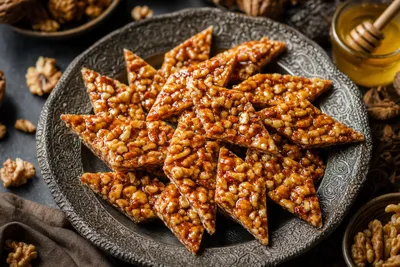
Pelamushi, known in some kitchens as tatara, comes from Imereti and is the dessert of the grape harvest: nothing more than light grape must cooked down to badagi and stirred with flour into a thick, glossy cream. As it sets, a matte, faintly crystallised skin forms on top — that belongs to the dish and tastes of pure grape sugar. Add walnuts, and that's all it needs.
Ingredients
- 6⅓ cupsgrape juicepreferably light, sweet must; reduced by half or ready-made badagi
- 12⅓ ozwheat floursifted
- 3½ ozreplaces part of the wheat flour (optional)Finely ground whole maize, yellow or white; not the same as cornstarch, which British English also calls cornflour.Substitute: Fine cornmeal or polenta, ground a little finer in a blender, works well but gives a grainier, more crumbly result. Cornstarch is not a substitute.Read more
- 3½ ozwalnutshalves pressed in or coarsely chopped for sprinkling
- 2 tbspsugaronly if the must is not sweet enough (optional)
Method
- Boil and skim the mustBring the grape juice, ideally a light, sweet grape must, to a boil in a wide pot, skimming off the foam as it rises.
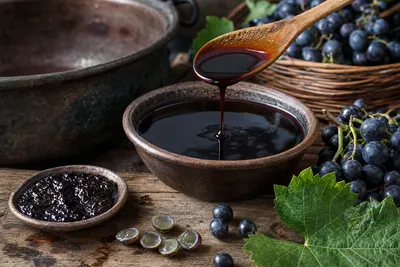
- Reduce and strain the mustKeep reducing the must until it has roughly halved and smells distinctly of badagi, then pour it through a sieve into a bowl or jug.
- Divide the must and heatSet aside about a third to half of this reduced must and let it cool completely, then heat the rest in a heavy pot.
- Make a smooth flour slurrySift the wheat flour — or the wheat and corn flour together — and work in the cold must in a thin stream, stirring constantly, until you have a completely smooth, lump-free slurry; blend it briefly or pass it through a sieve if needed.
- Stir the slurry into the mustPour the slurry slowly into the hot must, stirring vigorously with a wooden spoon.
- Cook until thick and glossyCook over low heat, stirring without stopping, for 10 to 20 minutes, until the mixture is thick and glossy, no longer tastes of raw flour and pulls away from the side of the pot; if the must is not very sweet, stir in the sugar towards the end.
- Fill moulds and add walnutsQuickly pour the hot mixture into bowls, onto plates or into small moulds and smooth the surface, then press the walnut halves into the still-warm top or scatter over the chopped nuts.
- Set, chill and serveLet the pelamushi set for several hours at room temperature, then chill it and serve either cold or at room temperature.
Tips and variations
Instead of wheat flour alone, you can swap part of it for fine corn flour, which gives the mixture a slightly grainier bite. Some cooks bring the thickened mixture to a hard boil once, briefly, and then turn the heat right down for the rest of the cooking. Others never let the mixture boil at all and keep it just below a simmer the whole time, so it thickens slowly. The walnuts can go in as halves pressed into the warm surface, or be chopped and scattered over once it has cooled. Poured into small moulds, pelamushi can be turned out like a jelly once it has set. While still warm, the mixture also serves as the classic dipping mass for churchkhela. It also makes a lovely filling for choux pastry eclairs (water, milk, butter, flour, eggs; baked 20 minutes at 180 °C, then finished at 160 °C). Serve it in small bowls with coffee, or as a light finish to an autumn meal.
Allergens
Contains: Cereals containing gluten, Tree nuts
These notes follow from this recipe's ingredient list. Ready-made products and brands may contain further allergens — please check the packaging yourself.
Something not right?
This recipe was put together from independent sources and checked before publishing. Even so, a mistake can slip through — an amount that does not add up, a step that does not work as written. If you spot something, write to us: we will look into it and put it right.